English
 中文简体
中文简体 Deutsch





Content
When a piping specification calls for carbon steel flanges, the material line almost always reads ASTM A105. It is the default forged carbon steel grade for flanges, valves, and other pressure-containing components, and it shows up across oil and gas, chemical, power, and general process piping. The reason is straightforward: A105 delivers a dependable combination of strength, ductility, and machinability at a price that is hard to beat. What is easy to forget is that "A105" is not a complete purchase specification. You still have to choose the pressure class, face type, dimensional standard, and documentation requirements. This guide explains what the grade actually guarantees, where its limits sit, and what should be verified before a flange order reaches the shop floor.
What Is ASTM A105 Forged Carbon Steel?
ASTM A105 is the specification for forged carbon steel piping components intended for ambient and higher-temperature service in pressure systems. It is not a casting grade and not a structural plate grade. It covers forgings — flanges, fittings, and valve bodies — that are shaped by hot forging and then machined to final dimensions. Because the material is forged, the grain flow follows the shape of the component, which gives flanges better resistance to impact and fatigue than parts simply cut from plate or bar.
This is also the grade behind most catalog A105 carbon steel flanges used in plant construction, from welding neck and slip-on styles to blind and socket-weld types. When a system needs a flange that can be hydrostatically tested, code-stamped, and trusted in pressure service, A105 is the normal starting point.
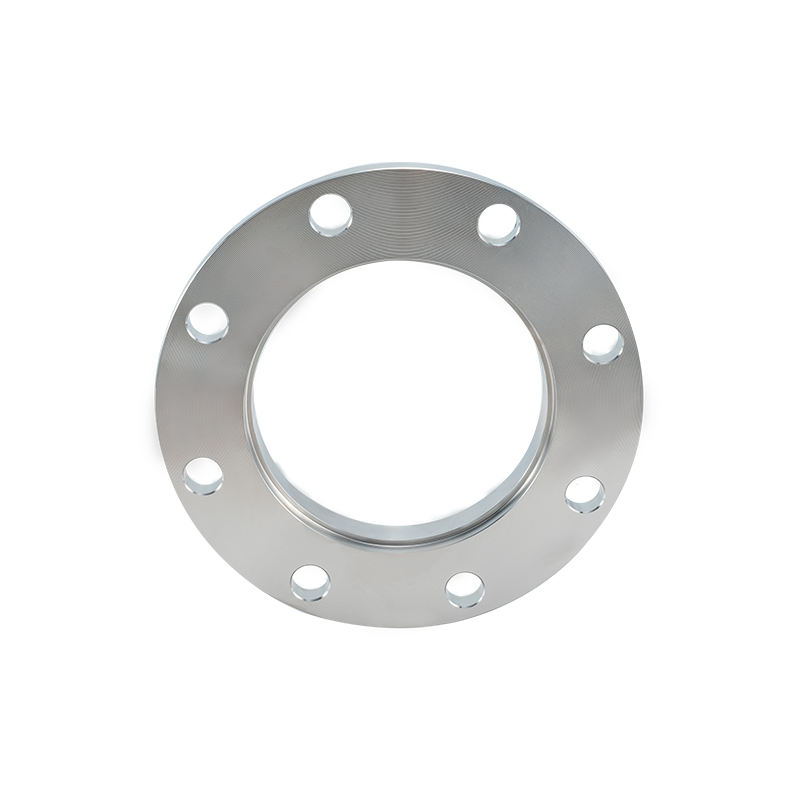 Custom A105 Carbon Steel Flange Manufacturers, FactoryJiangyin Zhonghai Precision Machinery Co., Ltd. Is China A105 Carbon Steel Flange Manufacturers, Factory, We Custom & Standard Flanges (G...View Product →
Chemical Composition
The chemistry of A105 is controlled tightly enough to keep the steel forgeable and weldable while still predictable at elevated temperature.
| Element | Wt % |
|---|---|
| Carbon | 0.35 max |
| Manganese | 0.60–1.05 |
| Phosphorus | 0.035 max |
| Sulfur | 0.040 max |
| Silicon | 0.10–0.35 |
| Copper | 0.40 max |
| Nickel | 0.40 max |
| Chromium | 0.30 max |
| Molybdenum | 0.12 max |
| Vanadium | 0.08 max |
Mechanical Properties
A105 forgings must meet minimum tensile and hardness requirements. These figures are not remarkable by alloy steel standards, but they are more than adequate for the great majority of carbon steel piping services.
| Property | Value |
|---|---|
| Tensile strength | 485 MPa (70 ksi) min |
| Yield strength | 250 MPa (36 ksi) min |
| Elongation in 50 mm | 22% min |
| Reduction of area | 30% min |
| Brinell hardness | 187 HBW max |
The practical limit is temperature. Flanged joints in A105 are normally considered usable from about -20°F (-29°C) to 1000°F (538°C). Above that point carbon steel loses strength quickly, and the specification decision should move toward stainless or alloy grades.
Standards and Pressure-Temperature Ratings
The material grade defines what the flange is made of; the standard defines its geometry, tolerances, and rating. Most A105 flanges are manufactured to ASME B16.5, which covers pipe flanges from NPS 1/2 through NPS 24 in classes 150 to 2500. Larger sizes fall under ASME B16.47. For projects outside North America, A105 material is also used to make flanges to EN 1092-1, JIS B2220, GB, or DIN dimensional standards when the buyer specifies ASTM material.
ASME B16.5 Rating Group for A105
In the ASME B16.5 pressure-temperature tables, A105 is listed under Group 1.1. Most carbon steel flanges used in process piping come from this group, and it is the column inspectors check first when a design is reviewed.
Working Pressure at Temperature
Pressure ratings are never a single number. The allowable working pressure drops steadily as temperature rises, so a flange tagged "Class 300" is only as strong as the service temperature allows.
| Temperature (°F) | Class 150 (psig) | Class 300 (psig) | Class 600 (psig) |
|---|---|---|---|
| 100 | 285 | 740 | 1480 |
| 400 | 200 | 635 | 1265 |
| 600 | 140 | 550 | 1095 |
| 800 | 80 | 345 | 690 |
| 1000 | 20 | 85 | 170 |
These numbers explain real design decisions. A Class 150 A105 flange is entirely reasonable for a cooling water system at ambient temperature, but a 600°F steam line usually requires Class 300 or higher to keep an acceptable margin. If you are comparing classes for a particular pipe size, the ANSI pressure class selection guide covers the trade-offs in more detail.
Common A105 Flange Types
A105 is a material, not a geometry. The same forging specification is used to make every common flange type, and the correct choice depends on pipe size, pressure, cyclic loading, and how often the joint has to be opened. Each geometry has its own welding, alignment, and cost profile, and the differences between the three most common styles are covered in the weld neck, slip-on, and blind flange comparison.
Weld Neck Flanges
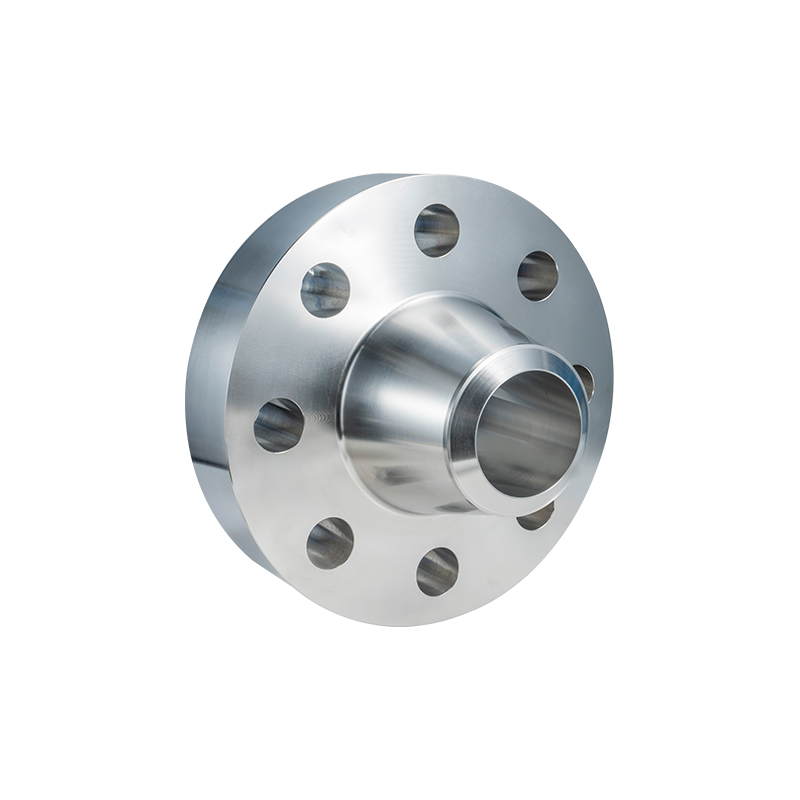
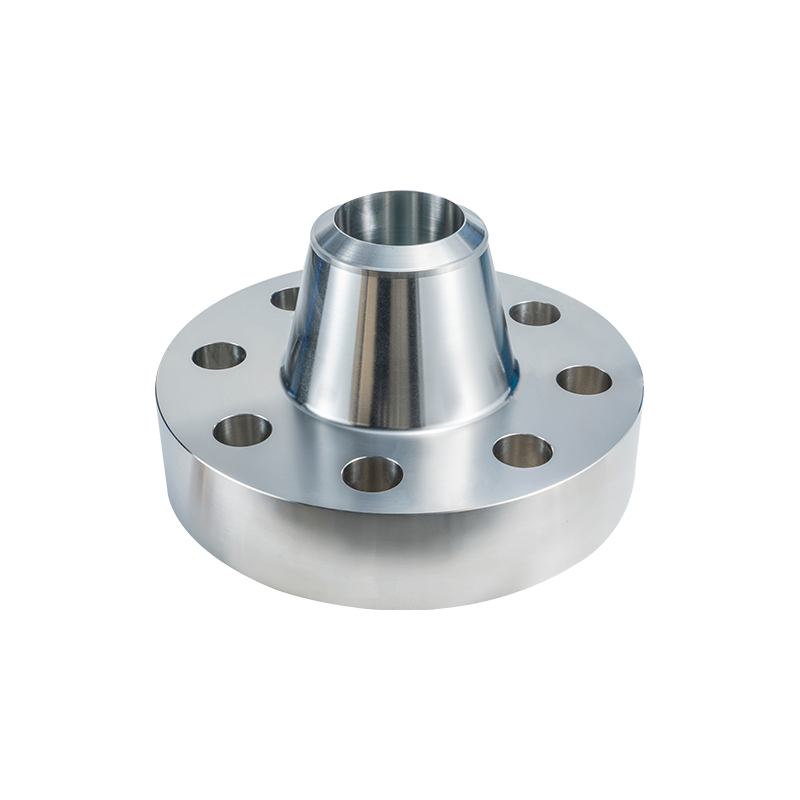
The weld neck flange is butt-welded to the pipe, which creates a full-strength joint with no added bending stress at the connection. The tapered hub distributes stress smoothly from the flange ring into the pipe, making this the preferred type for high pressure, elevated temperature, and cyclic or vibrating service.
Slip-On and Socket-Weld Flanges
Slip-on flanges fit over the outside of the pipe and are fillet-welded on both the front and back faces. They are easier to position and less expensive to install than weld neck flanges, which makes them common in low and medium pressure piping. For small bore lines, socket-weld flanges perform a similar role with the pipe inserted into a counterbore. In low-pressure water and utility service, Class 150 slip-on flanges are among the most economical options.
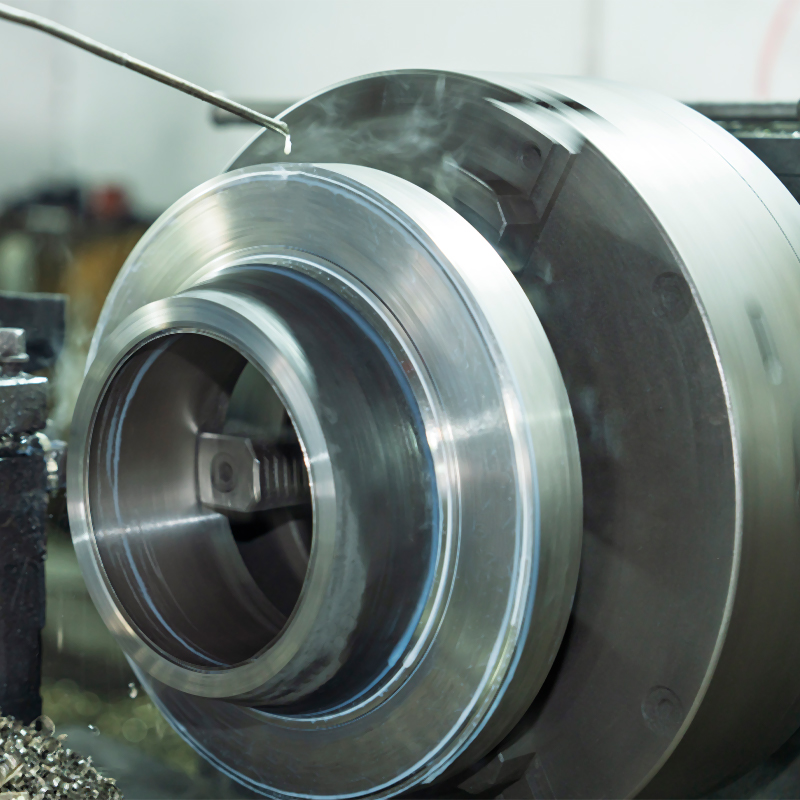 Custom Class 150 Slip On Flange Manufacturers, FactoryWe Are Class 150 Slip On Flange Manufacturers, Factory, Jiangyin Zhonghai Precision Machinery Co., Ltd. Offer Custom Class 150 Slip On (S...View Product →
Blind Flanges
Blind flanges are used to close off a line, a vessel nozzle, or a valve end. Because the full internal pressure acts on the flat plate, a blind flange in a given class is usually thicker than a similar bore flange — and it is the right choice whenever a line has to be isolated with the option to reopen it.
Lap Joint and Threaded Flanges
Lap joint flanges ride behind a stub end, which lets the flange rotate for easy bolt alignment and makes dismantling simple. They are useful where piping has to be lined up frequently or where space is tight. Threaded flanges are now limited mostly to small-bore, low-pressure, non-welded connections, although they are still produced in A105 for niche applications.
A105 vs A36 vs Q235B: What Counts as an Equivalent
Substitutions appear in the market, especially on non-standard fabrications, so it is worth knowing which materials are not equivalent. The carbon steel flange types, uses, and material guide describes where carbon steel fits in piping systems; the comparisons below cover the three grades most often confused.
A105 vs A36
A36 is a structural carbon steel sold as plate, bar, and shapes. It is not a pressure-grade forging specification. A flange machined from A36 plate can show a similar room-temperature yield strength, but it lacks the controlled forging process, heat treatment requirements, and material traceability that ASTM A105 demands. For code-stamped pressure service, A36 is not an equivalent and should not be substituted.
A105 vs Q235B
Q235B is a Chinese structural carbon steel that occasionally appears in low-cost flange supply. It works for non-pressure structural components, but it is not designed or tested for flange pressure service. The ASME B16.5 rating tables assume Group 1.1 materials such as A105; a Q235B flange has no defined place in those tables. Using it in a pressure boundary is a risk to the whole joint, not just to the flange itself.
A105 vs Stainless Steel Flanges
For all of A105's strengths, it is still a carbon steel. It will rust if left unprotected, and it is not the right choice for strongly corrosive media, chloride-rich environments, or very low temperature service. Those conditions push the specification toward stainless grades such as F304 or F316, which carry their own pressure ratings and cost significantly more. The material selection should be driven by the fluid, not by the flange price.
What to Confirm Before Ordering A105 Flanges
The real cost of a wrong flange is not the flange itself. It is the line that stops, the gasket that leaks, or the hydrotest that fails. The following checks keep those risks low:
- Material certificate and traceability. Require an EN 10204 3.1 certificate or a mill test report that ties each heat number to the forgings actually delivered.
- Marking. Flanges should carry the manufacturer's identification, the material grade (ASTM A105), pressure class, size, and heat code in accordance with MSS SP-25.
- Face type and finish. Raised face is the default. Confirm that the serrated finish is in the 125–250 µin AARH range for standard gaskets, and specify flat face for cast iron equipment or RTJ for ring-joint service.
- Low-temperature toughness. For service below -20°F, specify normalized A105 (A105N) or Charpy impact testing according to ASTM A961.
- Dimensional verification. Check bore, outside diameter, thickness, bolt circle, and facing against ASME B16.5 tolerances. A deviation of even a few millimeters creates bolt alignment problems on site.
- Supplementary testing. Hydrostatic, PMI, ultrasonic, or magnetic particle examination can be specified when the flange goes into critical or high-pressure service.
- Storage and coating. Carbon steel flanges flash-rust quickly in humid conditions, so the coating, thread protection, and packing method should match the planned storage time.
Standard catalogs cover a large share of demand, but projects still end up with unusual bores, custom facings, or dimensions that no stock item matches. A forging-based manufacturer with flexible production can cover those cases; our non-standard forged flanges are made to customer drawings when catalog geometry does not fit the line.
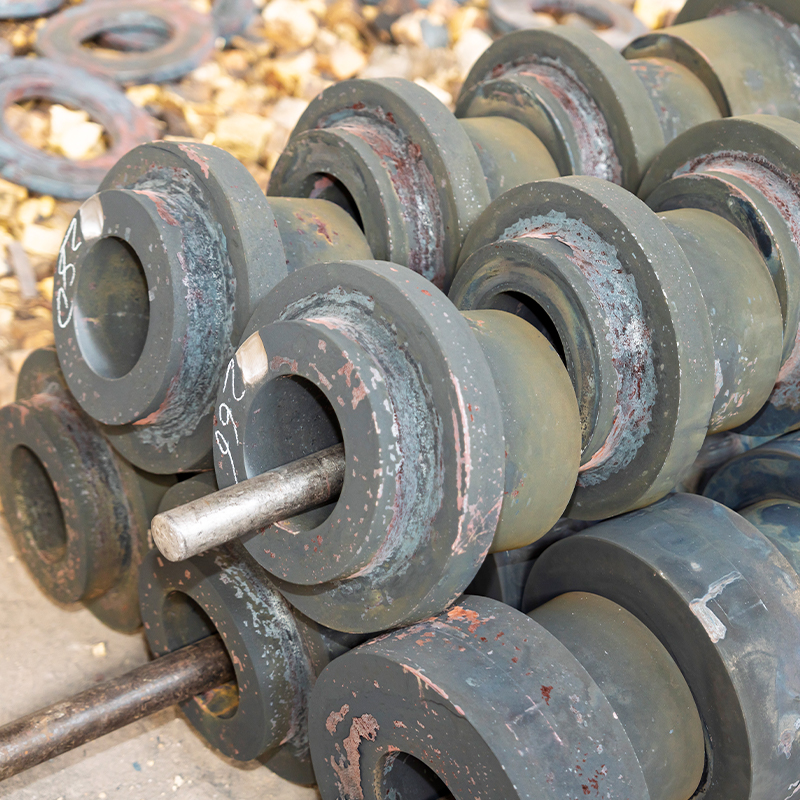 Wholesale Non-Standard Flanges Suppliers, Exporter, CompanyJiangyin Zhonghai Precision Machinery Co., Ltd. Is China Non-Standard Flanges Suppliers, Exporter, Company, We Wholesale 1/2'' To 60'', W...View Product →
Conclusion
ASTM A105 remains the most practical and cost-effective starting point for carbon steel flanges in pressure service. It forges well, welds readily, and its pressure-temperature behavior is documented in the ASME B16.5 rating tables that engineers and inspectors already trust. Treat A105 as one part of a complete specification rather than a shorthand: match the pressure class to the service temperature, choose the right flange type and face finish, require the material certificate, and confirm the marking. When those details are in place, a carbon steel flange joint performs exactly as the drawings say it will.
 Previous