English
 中文简体
 Deutsch






Content
- 1 What a Spectacle Blind Is and Where It Sits in a Line
- 2 Standards, Sizes and Pressure Classes That Govern the Order
- 3 Materials and Service Windows
- 4 Changeover: Rotating a Spectacle Blind Without Damaging the Joint
- 5 Spectacle Blind or Paddle Blind: Choosing the Right Line Blank
- 6 Procurement and Inspection Checks Before the Blank Ships
- 7 Practical Questions Engineers Ask About Spectacle Blinds
Line Blanks and Positive Isolation
A spectacle blind does something no valve can claim: it places a solid steel disc in the flow path, so isolation is visible, physical and verifiable during a walk-down. The trade-off appears at bolt-up. Every line blank adds its own plate thickness plus two gasket faces to a joint, which means longer studs, a wider flange spread and enough clearance for the plate to swing on a single bolt. Get any one of those three wrong and the blind arrives on site as the correct part that will not fit.
NPS 1/2 to 24Size range covered by ASME B16.48 line blanks
Class 150 to 2500Pressure classes listed in the same thickness table
90 degreesPlate rotation between the open and closed position
This guide covers the hardware itself: how ASME B16.48 sets size, class and thickness, which materials hold which service windows, how a changeover is actually executed, and which checks catch a bad blank before it reaches the flange.
What a Spectacle Blind Is and Where It Sits in a Line
A spectacle blind is a single-piece line blank formed from two discs joined by a narrow web: one disc is solid, the other is an open ring, and the pair rotates about one bolt to move a line between full isolation and full bore.
The part is also sold as a figure-8 blind, a spectacle plate or a spectacle flange, and all three names describe the same geometry. Its outside diameter, bolt circle and drilling follow the mating flange rather than the pipe. The web is positioned to pass between two bolt holes, so the plate can turn on one stud without the web fouling the next stud.
Definition: a spectacle blind is a rotatable line blank whose solid disc provides full-bore isolation and whose open ring restores full flow, both formed in one component with no loose parts to store, tag or mis-install.
The open ring is not a flow element. Its bore matches the pipe inside diameter so that, in the open position, it adds no measurable restriction and no additional pressure drop. It exists to keep the joint at the correct spacing while the line runs.
| Type | How the line is switched | Isolation | Typical application |
| Spectacle blind (figure-8) | Rotate one piece on a single stud | Full, both discs in one part | Lines needing frequent, verifiable isolation |
| Paddle blind with spacer | Remove paddle, insert spacer, re-torque | Full | Large sizes or tight layouts without swing room |
| Spacer ring | No switching, holds the joint gap | None | Keeps the joint when the paddle is removed |
| Blind flange | Bolt a solid flange onto the pipe end | Full, permanent | Pipe ends, future tie-ins, hydro tests |
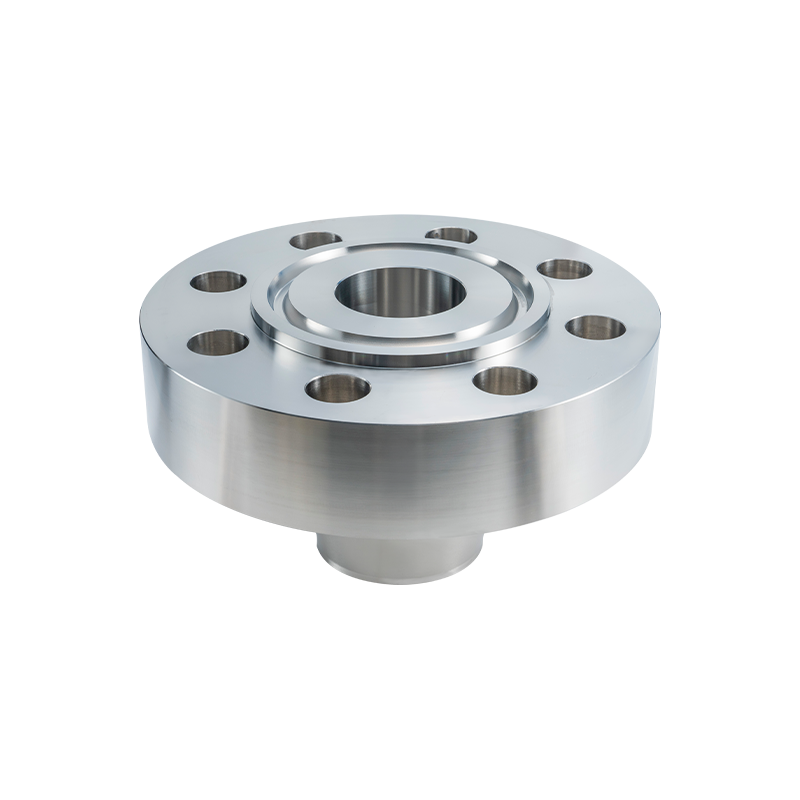
Where a line needs a permanent closure rather than a rotatable plate, the correct component is a blind flange bolted over the pipe end; a line blank is maintenance hardware, a blind flange is a closure.
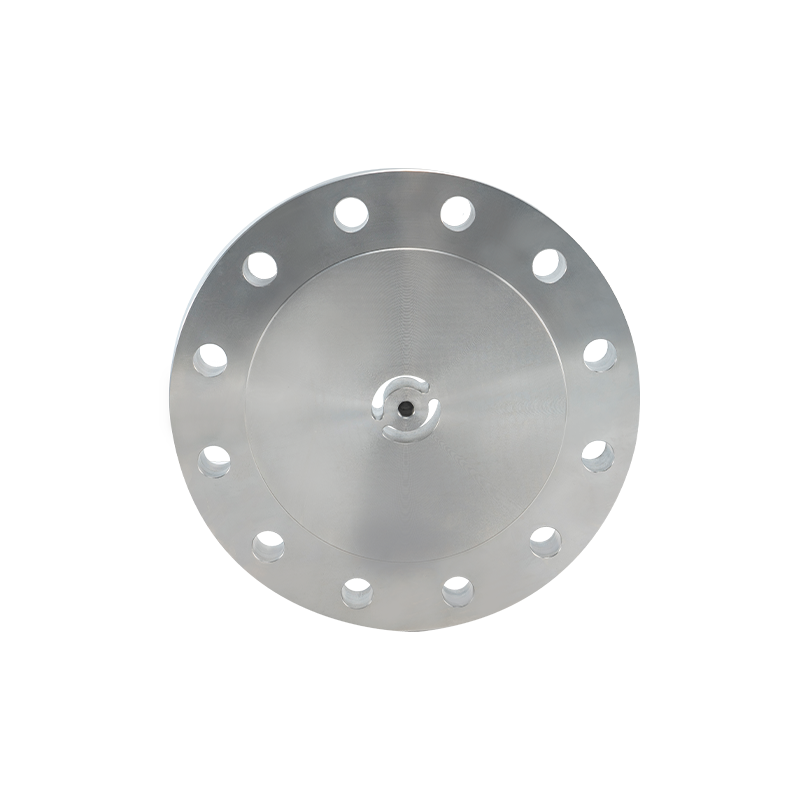 Forged Steel Blind Flanges for Pipe End ClosureThese forged blind flanges provide permanent pipe-end closure for pressure testing and maintenance, with RF, RTJ or FF faces and multiple steel grades.View Product →
Standards, Sizes and Pressure Classes That Govern the Order
ASME B16.48 is the governing specification for steel line blanks, covering NPS 1/2 through NPS 24 in Classes 150, 300, 600, 900, 1500 and 2500, and it replaced the earlier API 590 line blank standard that many older drawings still cite.
The class marked on the blank must equal the class on the mating flange. A Class 150 blank installed in a Class 300 joint is a pressure boundary that fails the moment the assembly is shell-tested. ASME B16.5 sets the minimum hydrostatic shell test pressure for each class, and the line blank sits inside that same pressure envelope.
ASME B16.5 minimum hydrostatic shell test pressure by class, MPa
Class 1503.1
Class 3007.8
Class 60015.3
Class 90023.1
Class 150038.4
Class 250063.9
Values converted from the psi figures in ASME B16.5 test tables; the blank, the gaskets and the studs must survive the same test.
Thickness is set by the solid disc, not by the ring. B16.48 tabulates blank thickness against nominal pipe size and class, and the same table fixes the web width and the ring bore. A blank machined to the thickness of the neighbouring flange hub is not a B16.48 part, whatever the marking says.
European pipework uses DIN 2690 spectacle plates matched to EN 1092-1 flanges, and Japanese projects reference JIS B2220 pressure ratings. Dimension tables for ANSI B16.5 and JIS B2220 blank sizes are collected in this blind flange size chart, which is the right starting point when a drawing gives only the flange size.
Materials and Service Windows
ASTM A105 carbon steel covers the standard range of water, steam, oil and gas service, with ASME B16.5 ratings extending to 538 degrees Celsius (1000 degrees Fahrenheit); below minus 29 degrees Celsius, or in sour and chloride-bearing duty, the blank has to change grade.
| Grade | Specification | Service window | Selection note |
| A105 carbon steel | ASTM A105 | Minus 29 to 538 degrees Celsius | Default for water, steam, oil and gas |
| A350 LF2 | ASTM A350 | Down to minus 46 degrees Celsius | Impact tested for low temperature duty |
| F304 / F304L | ASTM A182 | General corrosive and oxidising service | No chloride stress corrosion resistance |
| F316 / F316L | ASTM A182 | Chloride-bearing, marine, chemical | Molybdenum addition improves pitting resistance |
| F51 / F55 duplex | ASTM A182 | Offshore, high chloride, sour | Higher yield strength; F55 reaches PREN above 40 |
| Nickel alloy | ASTM B564 | Severe acids and high temperature | Highest cost and longest lead time |
Sour service is governed by NACE MR0175 / ISO 15156, which caps hardness and requires the heat treatment route to be documented. For a spectacle blind this means the certificate must show the hardness test result in addition to the chemical composition, because the solid disc is a full pressure boundary and not a spacer.
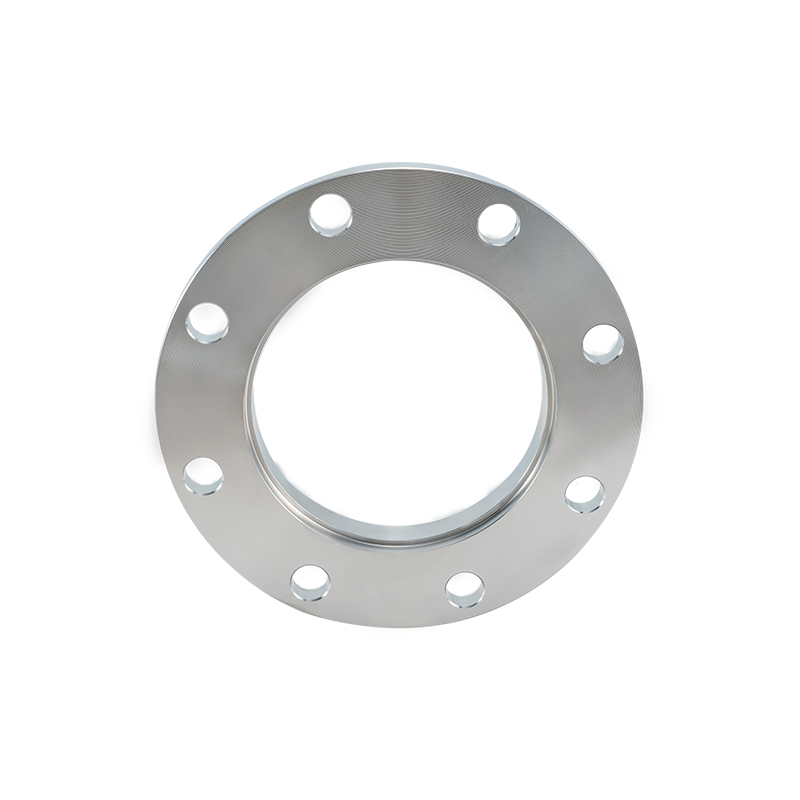 Custom A105 Carbon Steel Flanges for Pressure SystemsCustom A105 carbon steel flanges suit ambient and high-temperature pressure systems, with forging, heat treatment and CNC machining from 1/2 inch to 60 inches.View Product →
Changeover: Rotating a Spectacle Blind Without Damaging the Joint
A spectacle blind changes position by loosening the studs, spreading the joint by one plate thickness, rotating the plate 90 degrees around a single bolt, fitting new gaskets and re-torquing; the line must be depressurised, drained and purged before any of that begins.
- Isolate, depressurise, drain and purge the line, then prove zero energy at the bleed point. A line blank is a maintenance device, not a control element.
- Record the existing position and tag number, and photograph the joint before anything is loosened.
- Loosen the studs in a star sequence, keeping two opposing studs engaged so the plate cannot drop out of the joint.
- Spread the joint by one plate thickness using flange spreaders or wedges; on large sizes the plate weight makes hand rotation impractical.
- Rotate the plate on the pivot bolt until the required disc or ring aligns with the bore, keeping the web clear of the studs.
- Remove both old gaskets. A gasket that has seen service is already compressed and cannot be reused.
- Fit new gaskets, torque in a star pattern to the gasket supplier's figures, and update the isolation register and the tag.
Positive isolation practice on oil and gas gathering and processing lines follows the same sequence, with the added requirement that every blind position is logged against a tag number so the next shift knows exactly what is blocking the line.
Spectacle Blind or Paddle Blind: Choosing the Right Line Blank
Choose a spectacle blind when a line needs repeated, fast isolation and the layout leaves room for the plate to swing; choose a paddle blind with a separate spacer when the plate is too heavy to handle, the piping is too tight, or the joint cannot be spread far enough.
Spectacle blind (figure-8)
- One part, one rotation, no loose components to store or mis-fit
- Requires a clear swing arc equal to the plate diameter
- Needs longer studs and a wider flange spread at changeover
- Handling weight becomes the practical limit on large sizes
Paddle blind with spacer
- Two tagged parts: the paddle and the spacer ring
- No swing clearance needed; the paddle lifts straight out
- Changeover is slower and involves more loose hardware
- Preferred where plate weight exceeds manual handling limits
A spectacle blind is only as reliable as the space left around it. If the layout cannot give the plate a clear 90-degree arc, the correct part is a paddle blind, not a tighter spectacle blind.
Procurement and Inspection Checks Before the Blank Ships
Four checks catch most line blank rejections before shipment: correct class and drilling, correct plate thickness, correct facing finish, and complete material certification.
- Class and drilling: ASME B16.5 Class 300 drilling does not interchange with PN 40, and the blank must match the mating flange standard exactly.
- Thickness: verify against the ASME B16.48 table for the size and class; a plate "close to the flange thickness" is not a specification.
- Facing finish: raised faces for spiral wound gaskets are held at 125 to 250 microinch Ra, equivalent to 3.2 to 6.3 micron.
- Marking: heat number, size, class, grade and standard on the part, matching the certificate exactly.
- Certification: EN 10204 3.1 inspection documents, plus impact tests, PMI or NACE hardness verification where the service demands them.
- Custom sizes: above NPS 24 or with non-standard drilling, the blank is a forged and machined item rather than a catalogue part.
Jiangyin Zhonghai Precision Machinery Co., Ltd. produces line blanks and mating flanges under ISO 9001 with PED/TUV/TS qualifications, covering sizes from 1/2 inch to 60 inch and single pieces up to 10 tonnes, which is the range where oversized or non-standard blanks stop being a catalogue order.
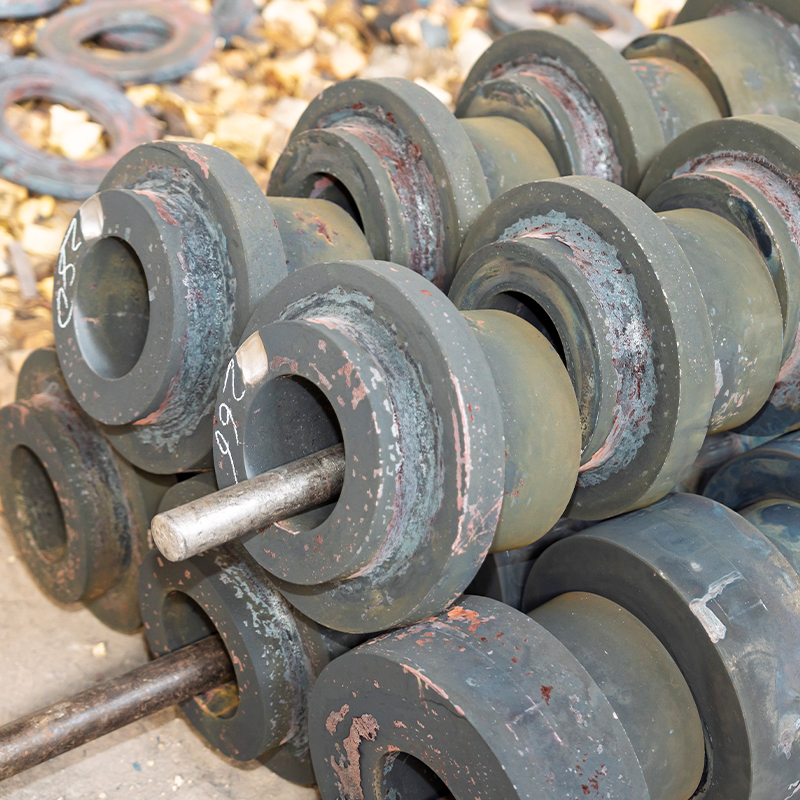 Custom Non-Standard Forged Flanges and RingsCustom-engineered forged flanges and rings are made to drawings for specialized pressure equipment, with diameters up to 4 meters and unit weights to 10 tons.View Product →
Practical Questions Engineers Ask About Spectacle Blinds
These are the points that most often decide whether a line blank is ordered correctly the first time.
Is a spectacle blind the same as a figure-8 blind?
Yes. Spectacle blind, figure-8 blind, spectacle plate and spectacle flange all describe one part: two discs joined by a web, one solid and one open, rotating on a single bolt. ASME B16.48 lists the geometry as a line blank, and the dimensions are fixed by size and pressure class rather than by the name used on the requisition.
How long do the studs need to be for a spectacle blind?
Add the blank thickness and two compressed gasket thicknesses to the original stud length, then confirm at least one full thread protrudes beyond each nut. A Class 150 joint on an NPS 6 line typically moves up one stud length increment, and that must be ordered with the blank, not after it arrives.
Which pressure class should I specify?
Match the class of the mating flange: Class 150, 300, 600, 900, 1500 or 2500 under ASME B16.48. Never install a lower-class blank to use up existing stock, because the assembly is tested to the higher of the two ratings and the blank becomes the limiting component.
Can a spectacle blind replace an isolation valve?
For maintenance isolation, yes: a closed disc provides a visible, full-bore barrier that no soft-seated valve matches. It cannot throttle flow, it cannot be operated under pressure, and every changeover needs a shutdown and two new gaskets, so lines that cycle daily still belong to a valve with a blind as the positive barrier behind it.
 Previous